Showing posts with label Old Bikes. Show all posts

Saturday, January 15, 2011

Harry Hawker - Racing the Boards...

I've just finished reading an excellent biography of Harry Hawker, the famous Australian aviator who flew the Atlantic in 1919 and was also the co-founder of the Hawker Aircraft company. He had moved to England in 1911 and ended up working for the Sopwith Aviation Company who were based at Brooklands. Inevitably, with some spare time on his hands he also raced cars and motorcycles around the legendary banked track.
Like so many people obsessed with machines and speed, Harry also had a love of motorcycles and built two of his own in a small workshop in Melbourne. His  favourite project was a high-powered motorcycle which used a v-twin engine that Harry built himself in 1909. The design was based on the British J.A.P v-twin engine with a few Hawker modifications. I was interested to read that Harry raced this bike on a board track in Australia, just like the great board tracks of America at the time. The biography says that...

"Harry raced against his friends Harry Busteed and Cecil De Faga who also built their own machines. Busteed's machine had enormous cyclinders but used a simpler side valve design. They raced on a steeply banked wooden track which was built for racing pedal cycles... The track was only an eighth of a mile and the high powered motorcycles soon started to shake the wooden structure to pieces"

They were eventually barred from using this track and took to racing on the country roads around Melbourne instead. Here's a few photographs of Harry Hawker and his friends with their homemade racing motorcycles at the Princes Park track, Melbourne, Australia.
Harry Hawker and Cecil De Fraga racing on the Princes Park board track in 1910 (Bob Chamerlain)
Cecil de Fraga with his v-twin Bouchet at Princes Park in 1909 (Bob Chamberlain)
Harry Busteed with his home made racing motorcycle. The engine was so large that Harry had to sit over the rear wheel and use long handlebars (Bob Chamberlain)
Information and photographs taken from "Hawker" A Biography of Harry Hawker by L.K.Blackmore. Published in 1990 by Airline Publishing Ltd. ISBN 185310437X.

Click the link for more information about the fascinating life and times of Harry Hawker.

Thursday, November 18, 2010

Original 1929 Douglas Dirt-Track Bikes for sale

The OldTimeSpeedway group has just highlighted these incredible and totally original 1929 Douglas dirt track bikes for sale. They were originally sold at Sotheby's in Australia in April 2010 and it looks like they're both up for grabs again. I've pasted in the original description from the Sotheby's catalogue which really brings the bikes to life.
1929 Douglas DT6 600cc 
Manchester born Reg Hunt came to Australia in 1949. His Grandfather, notable speedway and Isle of Man champion Pa Cowley and his daughter Dot being an integral part of speedway and dirt track track racing world in the UK between the Wars. Reg first rode the 600cc bike (lot 104) when he was 9 years old, then raced it at Charnock Richard near Manchester when he was 14 years old. He had lied about his age to the race officials saying he was 17 in order to get the entry. He won that race. This was the beginning of his extraordinary life in motor racing achieving a spectacular career in hill climbing, trials and in Grand Prix Racing becoming a household name in Australian sporting history.

The two motor cycles offered are dear to Reg’s heart having been with him since the 1960s when he acquired the two Douglas machines in the UK bringing them back to Australia where he and his son Graham have enjoyed club level racing together.
 Douglas DT5 speedway bike
The Douglas Motor Cycle Company founded in Bristol, England in 1907, was at the forefront of innovative design right through to the 1950s. Its first success at the Isle of Man came in 1912 with Bill Bashall winning the ‘Junior TT’ at 39.65 mph. In 1920 Douglas introduced over head valves for racing bikes but the real technical advances came in the winter of 1922-23 when the Douglas designers, urged on by the famous Brooklands’ race, Freddie Dixon, introduced many major changes. The most significant change perhaps, being the now famous dropped frame providing many advantages for the TT machines and the yet to come dirt trackers. Most new TT models were also fitted with a front disc brake designed by the British Research Association, which also led to a model being called an R.A.

With this style of Douglas bike Tom Sheard won the 1923 500 TT, and Freddie Dixon won the first Sidecar TT, his machine also being fitted with a revolutionary banking side car. Many more TT and G.P. road racing successes followed, but it was in the new sport of “Cinders” or dirt track racing that the Douglas motor bikes really excelled. The low weight of the Douglas (approx 250 lbs) and low centre of gravity made this bike the machine to have. Ridden by stars such as Australian, Vic Huxley and the great American showman, “Sprouts” Elder, the Douglas dominated the world circuits in Australia, America, Argentina and England.

The Douglas is a machine held in such reverence amongst the cognoscenti that they rarely become available on the open market and more often than not most change hands between private collectors
The Douglas DT5 that may have been ridden by Lloyd "Sprouts" Elder
 Reg Hunt purchased the 500cc ‘Cinders’ dirt track bike on the understanding that it had once belonged to Sprouts Elder himself, distinctive by its silver frame a Signature of Sprouts’ bikes. It is highly original and in its dirt track form. The Ex-Pa Cowley 600cc Douglas has been fitted with alloy rims, Amal concentric Carbs and front drum brakes for road use. This engine was put together by Colin Clifford and Len Cole in England 20 years ago and has not been used since.

The same auction also had a Douglas DT5 Long-Stroke engine for sale. The engine was originally used on a 1929 dirt track bike and bears the engine number EL1013
1929 Douglas DT5 Long-Stroke Engine


Sunday, November 7, 2010

SCOTT - 1928 dirt-track model.

Back in 1928, there was a brand new motorcycle sport sweeping the nation, dirt-track racing, or speedway as it soon became, was a major attraction. Top riders were earning big money and every bike motorcycle manufacturer in the country wanted a piece of the action. Some of the bikes were very good, some were a total failure whilst others were just plain bizzare. Many of them didn't look like speedway bikes at all and were simply road bikes stripped of their lights, brakes and mudguards. It says a lot for the bravery of the pioneer riders that they actually raced some of these bikes on the cinders at all!

One bike that should never have been a success was the Scott... a 500cc twin cylinder two-stroke with water cooling and an unusual low slung frame. Produced in the Yorkshire town of Shipley, this was one bike that definitely did not look anything like a speedway bike... but amazingly, in the hands of a select few riders, the yowling Scott has gone down in history as one of the legendary bikes of the cinder sport.

Jeff Clew described the origins of the dirt-track Scott in his excellent book "The Scott Motorcycle - The Yowling Two-stroke".

The Scott Motor Cycle Company's involvement with dirt track racing occurred in a quite unexpected way. When Frank Varey was detailed to join the Scott riders party to the Isle of Man in the capacity of machine cleaner. Allan Jefferies begged him for the loan of his three-speed Super whilst he was away. Unfortunately, the Super was written off completely in a road accident that followed, when Allan was run into by the rider of a Scott sidecar outfit whose sidecar wheel lifted on a left hand bend. The crash did not do Allan much good either, for he suffered a fractured skull, cheekbone and jaw.

When he ultimately emerged from hospital it was obvious that a machine would have to be built from scratch, since even the Super's crankcase had been cut in two by the force of the impact. Putting their heads together, Frank and Allan decided they might as well build a machine that could be ridden on the cinders. And so, from a quite calamitous beginning, a dirt track Scott began to take shape. To assist with the finances, Allan promoted two meetings at the nearby Greenfield Dog Track and at various tracks in Lancashire.

According to Allan, it was Frank's superhuman strength and courage, coupled with their complete ignorance of steering geometry that made Frank such a spectacular favourite with the crowds. His lurid style of riding and the scream of the Scott on full power drew spectators in large numbers and soon word got around to Harry Langman, who took such an interest in the project that it was decided to add a dirt track model to the official Scott range. Cecil Knowles of the Frame Shop organised production, using a frame that was a cross between that of the Flyer and the Super, a formula worked out by Frank and Allan the hard way.

The dirt track model neared completion one Saturday lunch-time, on the day when Frank was due to ride his own model at Bolton the same afternoon. Anxious to give the new model an early try-out, Allan agreed to remain at work so that the new model could be completed in time for delivery to Rochdale Town Hall Square by tea-time, to enable Frank to try it at an evening meeting in Salford. In return, Allan would take over the old machine, so that he could have a ride at Rochdale.

Like all deadlines, the completion of the machine was met with some difficulty, but Allan eventually set off for Rochdale, just in the nick of time. Both riders agreed to meet up towards midnight at a much-favoured steak pudding shop in Littleborough, where there was a parrot they were teaching all kinds of quite unmentionable phrases. When they finally got together, Frank was clutching a Golden Helmet, the major award presented to the star of the meeting at Salford. The parrot learnt much that night during the session that followed.

El Diablo Rojo - Frank Varey on the Scott that brought him glory as a pioneer speedway star.
The Scott employed an open frame and a TT engine, and it was said that the Heart-rendering yowl of this particular machine was terrifically exciting. The dirt-track model had a 3-speed gearbox, specially braced Webb forks of the old type, (later fitted with "Super Squirrel" type forks) a smaller than standard radiator and a very neat exhaust system. There was no Kick start on these Scotts and the entire Primary and magneto transmission was enclosed, the abscence of exposed mechanism was a noteable feature. The cost of a brand new machine in 1928 was £95.
The legendary Frank Charles from Roose near Barrow-In-Furness aboard his Scott in 1929
Juan Pagano, another Belle Vue rider who favoured the Yorkshire built Scott
The bike really did require an unorthodox riding style and mighty muscles to manhandle it around the cinder bends. Very few mastered it, but Frank Varey, "El Diablo Rojo" as the fans called him, (yes the Red Devil himself) got the necessary technique off to a tee, even though it's lack of ground clearance led to chamfered frame tubes after every meeting. Other riders who rode the Scott included Arthur Franklyn, Frank Charles and Oliver Langton. Wilf McClure even raced a banking sidecar outfit using a dirt-track Scott. Frank Varey must have liked unusual bikes because when he eventually fell out with the Scott owners he changed his steed to a Norton, another bike with a short production run and featured in my earlier post here. His Scott eventually ended up in the hands of another Belle Vue rider, Frank Burgess who rode the bike with some success at Workington and Barrow in the early 1930s.
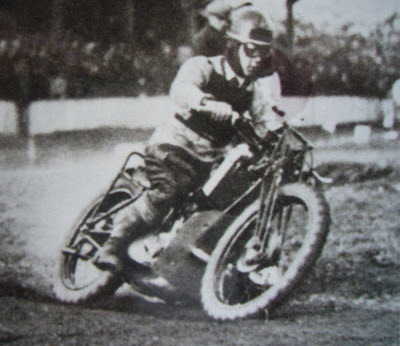
Frank Burgess in action at the Holker Street track, Barrow-In-Furness, 1930.
*Footnote* Even though Frank Varey is always associated with riding a Scott, he only actually rode the machine on the dirt-tracks for 18 months. He rode it throughout the 1929 British season and took it to Argentina with him during the winter. When he returned to the UK in the spring of 1930, Varey was dismayed to find that the factory had done nothing to improve the DT Scott at all as they had been concentrating on developing a brand new 5-cylinder car engine. Varey walked out on Scott and after a brief flirtation with Norton he turned his allegiance to the Rudge. Ironically, Scott went into recievership shortly afterwards.

Thursday, October 21, 2010

Bob Magill and The American Racer

I have been hunting for a certain book for a number of years now, the book in question is American Racer by Stephen Wright, in particular volume 1, American Racer, 1900-1940, published at the authors own expense in 1979.

There are currently two copies on e-bay, one at £285 the other at £395! I guess it's a book that is rare and sought after, so much so that it has recently been reprinted in the USA by Megden Publishing Co, but still costs $125 to purchase and post to the UK. It looks like I'm going to have to bite the bullet though because the book really is worth owning for a student of vintage bike racing like me.

The book has been described as containing "indispensable information and many rare photos" and also as "a book handsome enough to rest on anyone’s coffee table". The author was also quite a charachter himself. His occupation at the time of writing the book was restoring and purchasing early American bikes for Steve McQueen’s collection... Oh yeah!

It is the amazing photographs that really bring the book to life though. One of the photographers credited for the bulk of the photographs in the 2nd volume is "Magill".

Bob Magill was a talented photographer who mainly worked in California during the late 1940s using a Kodak Medalist and several other medium-format cameras. He was also an accomplished machinist, he worked on the Apollo Space programme during the 1960s, built houses and worked in a Coast Guard sea-and-air-rescue unit during WW2. He was also full of tremendous stories that could be backed up with the prints he carried with him. Magill, like many photography purists of that era, could never get his head around the reasons why the news photography industry dropped medium-format cameras in preference for 35mm. "I can't understand why fellas use 35mm. The frame is so small, it's like shooting through a microscope". I wonder what he'd make of todays digital kit?

To get a feel for some of the wonderfully evocative and immensely detailed images that Bob Magill will be remebered for, here's a selection of his photographs that were reproduced for posterity on SuperbikePlanet courtesy of Dean Adams, who also provided the basis of the information on Bob Magill.

Actor and motorcycle racer Keenan Wynn (with cigar) out for a ride with his motorcycling mates.

Don and Marge Fera on a real 1940s American Harley-D Racer

Floyd Emde at the start of the 1940 Oakland 200 mile race.

Stripped down British Bikes on the start line at Lincoln Park.

The start line at Riverside in 1949

An Unknown "American Racer" at speed.


Thursday, September 23, 2010

BSA ICE RACER

Thanks to the influence of Maxwell over at the Corpses From Hell blog, I find myself searching the web for more examples of these BSA powered speedway bikes. Here's a wild Swedish Ice Racer belonging to Olle Andersson and captured from the fabulous Veteran Ice Racing & Speedway In Sweden website. The bike is a 1951 500cc BSA single with lethal spiked tyres, girder forks, sprung saddle and what looks like a very loud home-made "silencer".

...and this is the same bike after some remedial work has been done and speedway tyres fitted in place of the spiked ice racing items. Love that drum brake on the front wheel - now that's an interesting accessory on a cinder shifter.


Thursday, September 16, 2010

WARTIME SPEEDWAY SPECIALS

I've been swapping a few e-mails and pictures with Maxwell Paternoster over at the Corpses from Hell blog recently, mainly about methanol burning BSA engines and old speedway bikes with unusual British engines. MP had said asked if I had any images of these bikes in action and this is what I found... A few years ago Trevor Davies published a book on Warzone Speedway, the story of Armed Forces racing during WW2 and the years immediately afterwards. Included in the book are some of these amazing dirt track machines that the REME mechanics put together from damaged bikes and spare parts....
Triumph with reversed front forks - Egypt 1946

Alan "Dart" Clark on his Matchless engined machine - Hanomag 1950

A Matchless on the Hanomag track - 1950

The weather didn't stop practice either - Winter 1946

Racing at Hanomag, Germany 1946

All pictures are copyright of Trevor Davies - Author and Publisher of Warzone Speedway and Speedway Flyers

Wednesday, August 4, 2010

1932 EXCELSIOR J.A.P.

This amazing bike is an original and genuine TT machine from 1932, as ridden by Roland Stobbart from Aspatria, Cumbria. The bike is an Excelsior B14 Racer with a special long distance return sump engine. The original J.A.P engine has since received some modifications though. The brothers were both of speedway stock and utilised some speedway parts and technology to make the engine more competitive. The barrel is a home-made item cast from low expansion alloy, bored out and fitted with a steel liner. The 80mm piston is a speedway item as is the cylinder head and all of the crankcase parts on the drive side. The parts on the timing side are all home-made items again, (please read the comments from Paul Ingham at the end of this post). The engine was set up to run on methanol (speedway style) via an Amal carb, and the drive to the rear wheel was delivered through an Albion gearbox. The engine delivered nearly 40bhp at 6000rpm

The bike has remained in the family ever since and when Roland died in 1981 it moved into Maurice's workshop. The bike continued to be used in anger and has been ridden in classic hillclimbs by Maurice's youngest son Stuart Stobbart. Maurice cared and nurtured this bike as if it were his own and continued to fettle it right up until his death in 2001 aged 87.

I called round to see Maurice one Sunday afternoon and was surprised to find him sat quietly in the living room. "What's up Mo, why aren't you in the garage today?". "I've had a wee fall lad, nowt to worry about". Apparently, he'd collapsed while carrying the engine across his workshop and like a mother with her baby he'd resisted dropping it in case it got damaged and held it on his chest until his wife got home from church. An amazing man and an amazing bike.

* The bike was once featured in Performance Bikes magazine but was incorrectly labelled as a 1930 Excelsior Manxman - (hence the caption on the photograph at the top of the post). Paul Ingham has since been in touch and corrected this error. The bike is from 1932 and is not a Manxman - the "Manxman" was not produced until 1934. Thanks Paul

Saturday, July 31, 2010

BSA SAND RACER

Jim Scott's B31 BSA Sand Racer
(Photo by - MotoFreakoFoto)
The years immediately following WW2 were some of the best for grass track and sand racing in Lancashire and Cumberland. Even some of the smaller events could attract crowds of 5000 or more.

Sand races were held on the wide open sands of the Solway Firth and Morecmbe Bay, from the famous beach races at Southport Sands up to Skinburness near Carlisle. The bikes were mainly stripped down roadsters, with a smatttering of pre-war speedway and grass track bikes thrown in for good measure. The races were a mixture of straight line sprints and half-mile and one-mile ovals.

This particular bike is a single cylinder 500cc BSA and was raced by Jim Scott on the beaches at Skinburness, Morecambe and around Barrow-in-Furness. Jim had also been a novice speedway rider at Workington's Lonsdale Park during the early 1930s. This bike was rescued from a house clearance by John Fisher of Wiltshire and has now been restored as a B31 road bike. Personally, I think that's a shame. I would have kept it in its mean looking Sand Racing trim and preserved a bit of British Racing history.

Friday, July 30, 2010

メグロ350ccレックス號Y型 MEGURO ON THE DIRT TRACK

I  must thank my friend Streetracker for discovering this Japanese promotional film of the Meguro Rex-Y 350cc on You Tube. I've been looking for this film clip for ages.

The origins of the Meguro Works can be traced back to 1909, but the Meguro brand name does not appear until 1927. The company had begun to build motorcycles from sourced parts around 1922 and produced their first complete motorcycle in 1937 leading to major contracts to supply motorcycles to the Japanese Army and Police in 1939.


Motorcycle production was halted in 1941 when the Meguro Works was commandeered for the war effort and full production did not resume again until 1949. By the mid 1950s they were just about the biggest motorcycle manufacturer in Japan, producing 4-stroke singles and twins based quite closely on British and German designs, but financial difficulties forced Meguro into a business partnership with the Kawasaki Aircraft Company in 1960, leading to a full merger in 1963 and the formation of Kawasaki Auto Sales (the forerunner of the Kawasaki Motorcycle Company). Some of the first Kawasaki motorcycles were simply re-badged Meguro models and the Meguro logo actually formed part of the Kawasaki Motorcycles logo for many years after. Even today, the Kawasaki W650 model can trace its ancestry back to the Meguro K1 models from the late 1950s.

The best bit comes right at the end of the film though. There was once a time, pre Autorace and its regulation tarmac ovals, when the Japanese enjoyed dirt-track and speedway racing on tracks made from compacted volcanic ash. The Meguro single was the engine of choice for many Japanese riders at that time and here is some cinematic evidence of those oriental "go fast - turn left" race meetings. Check out their race suits, the big shoulder pads and goggles make them look like motorcycling Samurai... This is a fantastic piece of Japanese motorcycle history.
Tamagawa Olympia Speedway; November 6th 1949.

Wednesday, May 19, 2010

SPOTTED


One my way home from Amsterdam around this time last year I spotted these guy's

WW1 MOTORCYCLES - No2

A second selection of motorcycle images from the first World War.

Sunday, May 16, 2010

MOTORCYCLE ART; No3

A third selection of vintage motorcycle posters for your delectation...

Monday, May 3, 2010

Stella; The New Girl in Town:


David Uhl and UHL Studios do some amazing artwork of bikes, planes and girls. This video uses time lapse photography to show how "Stella" evolved aboard her Harley-Davidson in the 1920s... There's some more amazing artwork on the UHL Studios website, take a look and be seriously impressed.